

Views: 0 Author: Site Editor Publish Time: 2026-10-16 Origin: Site
Material yield loss in thin-gauge aluminum foil and flexible film converting costs facilities thousands of dollars daily. We often blame operators when wrinkling and registration drift ruin production runs. However, these recurring issues usually stem from systemic mechanical tension and tracking failures. You cannot fix micro-tension imbalances simply by adjusting manual dials. Upgrading equipment to include optical mark tracking provides a measurable, highly scalable intervention. High-tolerance converting environments demand this exact level of precision. Optical tracking dynamically reads material flow. It corrects microscopic deviations instantly before they cause expensive scrap.
This article gives you a technical evaluation framework for upgrading cutting equipment. You will learn how to integrate these advanced tracking systems without disrupting your existing production lines. We will comprehensively cover root causes, specific hardware synergies, and rigorous evaluation criteria. Adopting this knowledge ensures a seamless, highly profitable implementation process.
You must understand the theoretical mechanics governing thin substrates. Wrinkling occurs physically when compressive stress exceeds intrinsic material stiffness. Thin-gauge aluminum foil possesses virtually zero elasticity. Polymeric films stretch easily but snap back unpredictably under uneven loads. When compressive forces push inward across the web width, the thin material inevitably buckles. This buckling creates permanent creases. Operators cannot iron out these creases once they form.
Intermittent feeding systems inherently create dangerous tension gradients. Stop-and-go mechanical actions send localized tension spikes rippling through the moving web. These sudden spikes manifest directly as diagonal and longitudinal wrinkles. Uneven nip roller pressure drastically worsens this effect. A roller misalignment of just fractions of a millimeter concentrates massive stress on one single edge.
Do not underestimate the compounding cost of imprecision. Micro-misalignments cascade aggressively through your entire production line. Scrap rates multiply quickly. Downstream packaging machinery fails when sealing edges misalign during the final form-fill-seal process. For pharmaceutical packaging and food lines, these alignment failures introduce severe compliance risks. Poor seals compromise sterile barriers instantly.
A standard roll to sheet cutting machine for paper fails miserably in this environment. Paper features highly distinct structural recovery properties. Its natural fibrous nature absorbs minor tension shocks effectively. Aluminum foil and highly elastic polymeric films simply buckle or tear under those identical conditions. Standard equipment totally lacks the ultra-sensitive tension zoning required to process these unyielding materials successfully.
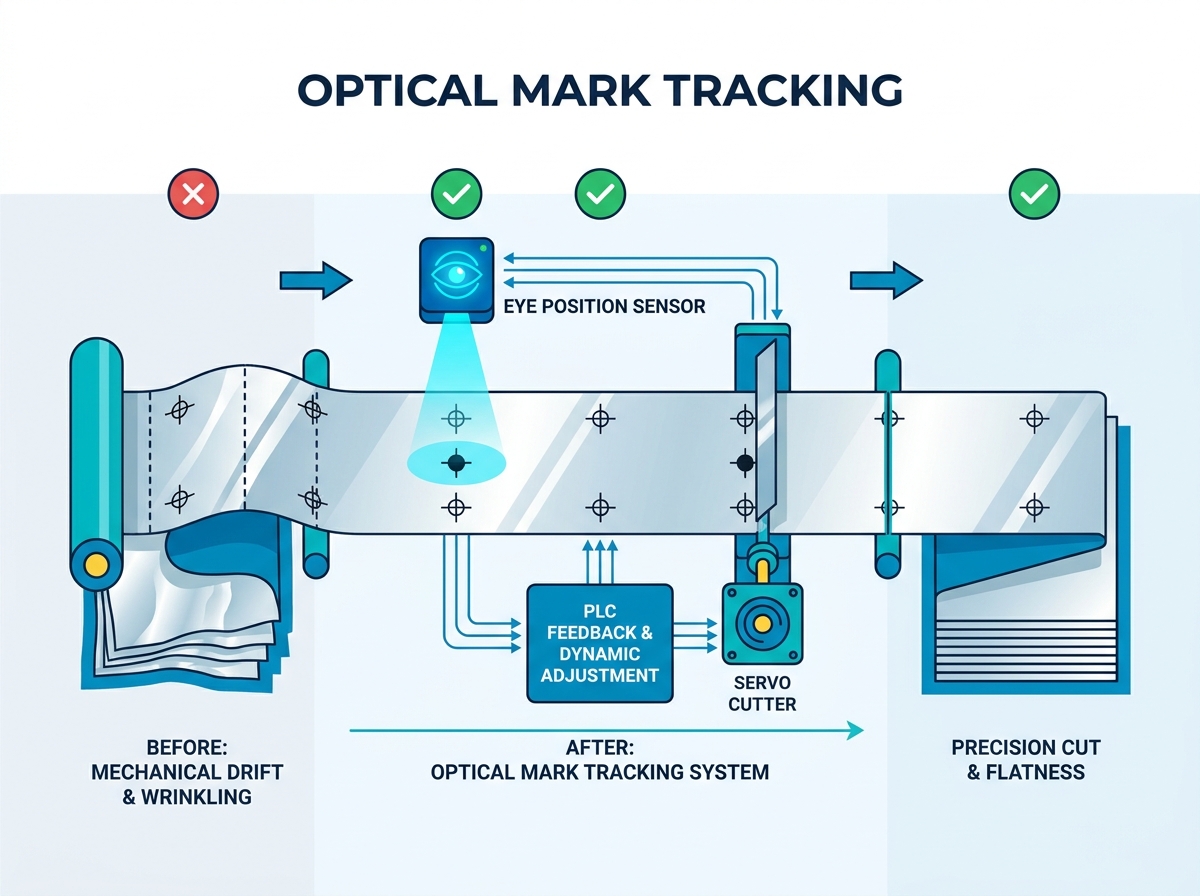
Let us break down optical mark tracking thoroughly. This technology relies entirely on a tightly integrated closed-loop feedback system. It features three interconnected core components. First, a highly sensitive color mark sensor scans the web surface. Second, a high-speed programmable logic controller (PLC) processes the incoming data. Third, a precise servo motor executes the physical mechanical adjustment instantly.
Materials stretch naturally during high-speed production runs. Thermal expansion and mechanical pulling cause this unavoidable elongation. The optical sensor detects these cumulative registration errors in real time. It measures the exact physical distance between printed contrast marks. The sensor sends electrical signals directly to the PLC. The system then micro-adjusts the mechanical cutting length dynamically. This happens without pausing the machine.
Traditional mechanical setups utilize predetermined length cutting parameters. If your web stretches by just 0.1mm per cycle, 100 consecutive cuts produce a massive 10mm error. An eye position roll to sheet cutting machine completely solves this problem. It resets the digital cutting baseline at every single printed mark. This optical dynamic length cutting eliminates cumulative alignment drift entirely.
You must always acknowledge implementation realities when deploying optical systems. Optical sensors demand highly specific operating conditions to function perfectly. You must guarantee clear contrast printing for all registration blocks. Proper sensor calibration remains strictly mandatory for every new material batch. Poor ink contrast, reflective surface glare, or ambient dust can easily trigger false positives. Dedicated clean operational zones and high-contrast inks prevent these frustrating sensor misreads.
Optical tracking cannot function accurately in a vacuum. It remains completely useless if the web flaps or sags momentarily. You must explicitly pair tracking sensors with advanced tension control systems. Engineers integrate magnetic powder brakes to expertly manage unwinding resistance. Dancing rollers and precision load cells physically absorb sudden tension shocks. They maintain absolute web flatness immediately before the critical cut cycle.
Blade selection dictates edge quality for extremely thin materials. We generally evaluate shear cutting, razor slitting, and crush cutting. Crush cutting utilizes a blunt wheel pressing heavily against a hardened anvil. It generates unacceptable dust levels. Razor slitting drags a stationary blade continuously through the web. This specific method struggles against dense metal foils, causing rapid blade wear. Guillotine-style shear blades represent the true industry standard. They require minimal clearance tolerances. This precise shear action is absolutely necessary for foil to prevent severe edge curling.
These strict hardware requirements transcend basic packaging applications. Tension stability and sharp, precise shear define top-tier converting globally. Facilities upgrading their foil lines frequently adopt baseline technology identical to a medical non-woven cutting machine. Medical manufacturing treats any particulate shedding as a critical systemic failure. Both sectors share rigid zero-tolerance policies for edge fraying, wrinkles, and micro-contamination.
Sourcing new precision equipment demands a highly structured approach. A comprehensive roll to sheet cutting machine buyer's guide goes well beyond basic output capacities. You must evaluate internal mechanical architectures carefully to ensure production reliability.
The first evaluation dimension involves sensor resolution and response time. Evaluate the underlying photoelectric sensor accuracy first. High-speed lines require sophisticated sensors capable of detecting microscopic color variations. Next, check the operational scanning frequency of the PLC. The system desperately needs microsecond response times. Fast responses adjust servo motors without slowing the main production line.
The second dimension covers material versatility. Assess whether the machine allows seamless operational toggling. Production floors require robust daily flexibility. You need reliable fixed-length cutting for blank webs. You simultaneously need highly accurate eye-position cutting for printed webs. Quick digital changeovers prevent costly machine downtime between completely different production runs.
The third dimension evaluates servo motor reliability. Always avoid stepper motors for foil conversion. Dual-servo systems drastically outperform single-servo or basic stepper motor setups. High-speed foil conversion demands physically isolated mechanical zones. One servo strictly manages precise material feeding. The second servo independently drives the heavy cutting blade. This mechanical decoupling prevents feeding stress from affecting actual blade force.
You must actively mitigate your procurement risk thoroughly. Demand rigorous Factory Acceptance Testing (FAT) from your selected vendor. Do not accept validation tests using generic printing paper. Specifically demand test runs using your exact aluminum material gauge. Ensure they test using your specific print contrast and specific ink reflectivity parameters.
Cutting Technology Capabilities Comparison
| Operational Metric | Mechanical Predetermined Setup | Optical Mark Tracking Setup |
|---|---|---|
| Cut Accuracy Maintenance | Drifts incrementally over time | Maintains exact continuous mark placement |
| Material Handling Suitability | Struggles heavily with thin foils | Ideal for high-stretch elastic films |
| Setup and Calibration | Requires manual dial adjustments | Utilizes digital HMI calibration |
Calculating the payback period requires clear data tracking methodologies. Build a comprehensive framework measuring direct operational improvements. First, strictly track reduced scrap material volumes. Second, monitor faster consistent line speeds. Third, log the minimized operator intervention required per shift. These direct efficiency gains accelerate your return on investment drastically.
Upgrading introduces a specific learning curve for your workforce. Digital Human-Machine Interface (HMI) systems replace familiar manual dials completely. Operators must patiently learn optical sensor calibration protocols. Modern touchscreens greatly simplify this transition phase. They provide clear visual error diagnostics and step-by-step digital recipes. Proper vendor training usually bridges this knowledge gap within days.
Plan carefully for long-term scalability. A modern roll to sheet cutting machine must support future factory floor expansions. Look for advanced systems offering digital workflow integrations. Choose equipment featuring predictive maintenance capabilities seamlessly built-in. Smart sensors actively monitor blade wear dynamically. They alert maintenance teams before dull edges cause micro-tears and costly downstream defects.
To integrate these advanced tracking systems efficiently, follow these sequential deployment steps:
The fundamental transition from relying on mechanical tension to embracing optical precision transforms production quality. Relying solely on simple mechanical grips guarantees failure when handling thin-gauge substrates. Optical mark tracking fundamentally solves destructive registration drift. It ensures every cut hits the exact printed mark.
Solving wrinkling permanently demands a truly holistic engineering approach. You must strategically combine eye-position tracking, strict tension control, and optimal blade selection. Each element heavily supports the operational success of the others.
Take action by scheduling a controlled material audit today. Test your specific foil or film directly on a vendor's optical machine. This critical step validates technical performance empirically before you finalize any procurement decisions.
A: A standard machine handles robust substrates easily. Aluminum foil requires significantly tighter blade clearances and active static elimination. Foil completely lacks the structural recovery properties found in paper. Therefore, specialized foil machines utilize highly sensitive tension control systems. These systems actively prevent irreversible stretching and buckling during the high-speed feed cycle.
A: Transparent films naturally confuse standard visible-light sensors. To resolve this, operators print high-contrast registration blocks directly on the film edge. Alternatively, facilities upgrade to specialized ultrasonic or capacitance sensors. These advanced sensors accurately detect thickness variations or specific material markings without relying purely on visible light reflection.
A: No. Optical tracking guarantees precise cut placement and actively eliminates registration drift. However, wrinkle prevention strictly requires optimal unwinding tension. You also need perfectly parallel idler rollers. If your mechanical web handling remains misaligned, the delicate material will still wrinkle long before it reaches the cutting blade.
A: Optical tracking specifically targets printed registration marks. However, the advanced dual-servo feeding mechanisms built into these optical machines remain highly beneficial. They ensure exact cut lengths and zero-tension feeding. These precise mechanical capabilities are absolutely critical for any medical non-woven cutting machine, even when processing entirely unprinted webs.
