

Views: 0 Author: Site Editor Publish Time: 2025-10-23 Origin: Site
In today’s manufacturing and packaging landscape, cutting machines play an essential role in transforming raw materials into precise, usable components. Whether you’re producing labels, films, laminates, or packaging sheets, choosing the right cutting machine can directly impact your efficiency, product quality, and profit margin.
The market offers a wide variety of machines—from manual cutters to semi-automatic and fully automated roll-to-sheet systems. Each type serves a specific purpose, depending on production scale and material type.
This guide will walk you through everything you need to know about selecting the best cutting machine to buy, from how they work to what features to prioritize for your business.
A cutting machine is designed to trim, slice, or divide raw materials into defined sizes and shapes. These machines are critical across industries like printing, flexible packaging, automotive interiors, and electronic insulation materials.
Modern cutting machines use mechanical or electronic control systems to guide blades or rotary knives along predetermined paths. Sensors detect material position and adjust the cutting stroke to maintain accuracy.
The cutting process usually includes:
Material feeding – rolls or sheets are fed into the machine.
Alignment – sensors and tension controllers ensure straight feeding.
Cutting operation – servo motors or pneumatic knives perform the actual cut.
Collection – finished sheets or pieces are stacked or rewound for the next process.
In high-end models, microprocessors or PLCs control the synchronization between feeding and cutting, allowing precise sheet lengths and minimizing waste.
Understanding the different categories of cutting machines helps you make a smarter and more cost-effective investment. Each type is designed to meet specific production demands, offering various levels of automation, accuracy, and efficiency.
Type | Automation Level | Typical Applications | Advantages | Limitations |
Manual Cutting Machine | Low | Small workshops, craft cutting, prototyping | Low cost, compact design, easy to operate and maintain | Slow operation, labor-intensive, limited accuracy |
Semi-Automatic Cutting Machine | Medium | Medium-scale production, flexible packaging, paper and film processing | Balanced performance, higher consistency, reduced manual effort | Requires manual feeding or supervision |
Fully Automatic Cutting Machine | High | High-speed industrial production, roll-to-sheet converting | Exceptional precision, continuous workflow, minimal labor | Higher initial investment and maintenance cost |
Beyond the level of automation, cutting machines differ in blade design, feeding mechanisms, and control systems. Rotary cutters are preferred for delicate film and flexible materials, while guillotine-style cutters are ideal for thick paper, cardboard, or laminated sheets.
Modern fully automatic models also incorporate servo control, photoelectric sensors, and tension adjustment systems to ensure stable feeding and high cutting accuracy across different materials and production speeds.
Selecting the best cutting machine involves balancing cost, speed, and precision. Let’s break down the main factors:
Each material reacts differently to cutting stress.
Paper & Film: Require low-friction feeding and rotary blades for smooth edges.
Plastic & Laminates: Benefit from sharp, temperature-resistant blades.
Foam & Rubber: Need soft-pressure cutters or oscillating knives to avoid deformation.
Textiles & Nonwoven fabrics: Perform best with ultrasonic or laser cutters.
Always confirm your machine supports the maximum thickness, hardness, and roll diameter of your raw materials.
High-precision cutting is crucial when your products must meet tight dimensional tolerances. Machines with servo-driven control, photoelectric sensors, and automatic calibration offer accuracy down to ±0.1 mm.
Cutting speed varies dramatically:
Manual: 50–100 cuts/hour
Semi-Automatic: 300–800 cuts/hour
Fully Automatic: 1000+ cuts/hour with continuous roll-to-sheet operation
Speed directly influences productivity and labor efficiency, especially in packaging and film industries.
Advanced models include programmable interfaces, automatic tension control, and recipe storage functions. These features allow repeatable performance for different materials and job orders without reconfiguration.
A well-built cutting machine should have:
Rigid frame structure (usually carbon steel or cast iron)
Heat-treated shafts and bearings for longevity
Blade materials like SKD11 or tungsten carbide
Routine maintenance—such as greasing moving parts and replacing worn belts—significantly extends machine life.
Manual cutters are perfect for entry-level use. They require operators to load materials and perform each cut manually. Their low cost makes them attractive for startups or prototyping tasks.
However, they’re limited by speed, operator fatigue, and inconsistent accuracy. Manual cutting machines are best suited for low-volume operations or tasks where precision is secondary.
These machines automate the cutting stroke while keeping manual feeding. The result is better speed and uniformity than manual types, without a major cost increase.
They also allow flexible control—operators can adjust cutting length or pressure manually for different materials.
For mid-sized packaging factories, this option often provides the best balance between investment and performance.
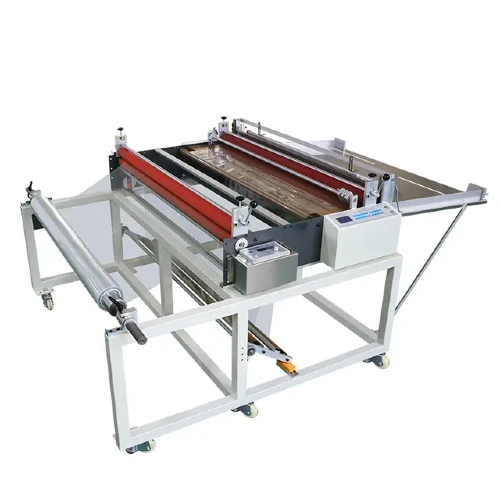
Fully automatic roll-to-sheet cutting machines represent the highest level of productivity. They integrate feeding, alignment, cutting, and stacking in one seamless process.
Features like servo motors, PLC systems, and optical tracking ensure consistent precision even at high speeds.
These machines can operate continuously, making them indispensable for industrial printing, flexible packaging, and electronic film cutting lines.
Investing in a high-quality cutting machine ensures consistent results and reduced downtime.
Servo systems precisely control movement, ensuring cutting length consistency. This reduces waste and supports synchronized operation with other production equipment.
Fluctuating tension can cause wrinkles or misalignment. Automatic tension controllers detect load variations and instantly adjust feeding speed. This results in smoother feeding and cleaner edges.
A digital control panel allows operators to input cutting length, speed, and batch quantity easily. Advanced systems can store multiple recipes, saving time when switching production jobs.
Safety should never be overlooked. Reliable machines include:
Emergency stop systems
Safety doors with interlocks
Overload protection
Power-off memory functions to resume production safely after interruptions
The cutting blade determines accuracy and durability. High-speed steel (HSS) or tungsten carbide blades are recommended for long service life. Some machines also allow easy blade replacement to minimize downtime.
The right machine should offer value beyond its initial price.
Machine Type | Price Range (USD) | Recommended For | ROI Period |
Manual | $800 – $2,000 | Small workshops, startups | 6–12 months |
Semi-Automatic | $3,000 – $8,000 | Medium-scale manufacturing | 12–18 months |
Fully Automatic | $10,000 – $30,000+ | Industrial lines, 24/7 production | 18–24 months |
When calculating ROI, include not only equipment cost but also labor savings, production uptime, waste reduction, and energy efficiency.
Fully automatic systems often recover investment faster due to reduced manpower and improved yield rates.
Consistent maintenance is key to maximizing lifespan and performance.
Remove dust, adhesive residue, and material scraps daily. Pay special attention to feeding rollers and optical sensors. Contamination can cause feeding errors and shorten component life.
Use recommended lubricants for sliding rails, bearings, and drive shafts. Over-lubrication should be avoided to prevent oil splashes on material surfaces.
Inspect blades regularly for dullness or nicks. Dull blades can tear materials, creating rough edges and increasing scrap rate.
Follow the manufacturer’s instructions for regrinding or changing blades.
Weekly calibration ensures precise cutting length and alignment.
Check for abnormal vibrations or noise—these could indicate bearing wear or belt misalignment.
Keep a maintenance log to track part replacements and performance trends.
Many buyers focus only on cost and overlook essential factors. Common pitfalls include:
Buying an undersized machine that can’t handle future production growth.
Ignoring the machine’s material compatibility or maximum roll width.
Choosing models without readily available spare parts or technical support.
Neglecting the importance of warranty, training, and after-sales service.
Avoiding these mistakes helps ensure long-term stability and lower total cost of ownership.
Technological innovation is reshaping the way materials are cut.
Smart Automation: Modern cutting machines now feature AI-driven adjustment systems that automatically optimize blade movement for material type.
Energy Efficiency: Manufacturers are developing servo systems and inverter drives that consume less power while maintaining speed.
Connectivity & IoT: Real-time production data can be monitored remotely, allowing predictive maintenance and quick troubleshooting.
Environmental Considerations: Eco-friendly designs reduce material waste and noise pollution, aligning with green manufacturing standards.
Adopting these advancements ensures better quality, reduced downtime, and sustainable operation.
There is no one-size-fits-all cutting machine. The right choice depends on your specific production scale, budget, and material type.
For small operations or startups, a manual or semi-automatic cutting machine offers flexibility at a low cost.
For industrial or high-speed production, a fully automatic roll-to-sheet cutting machine with servo control provides superior efficiency, precision, and reliability.
Before making a purchase, assess your long-term production needs, maintenance capability, and supplier reputation. A trusted manufacturer ensures not just a good product but dependable after-sales support and technical guidance.
For professional-grade, customizable cutting machine solutions, HDK Automation Equipment Co., Ltd. offers advanced systems designed for speed, stability, and precision.
