

Views: 0 Author: Site Editor Publish Time: 2026-11-20 Origin: Site
Bringing material converting operations in-house unlocks significant advantages for modern manufacturing facilities. You eliminate custom-width supplier premiums and drastically reduce your master roll inventory footprint. This shift ultimately improves daily production agility across the plant floor. By processing your own materials, you gain total control over lead times and final product quality.
However, many production managers encounter a confusing industry overlap between "slitting" and "cutting to length." Misunderstanding whether you need to narrow a web's width or transform continuous rolls into flat sheets often leads to misaligned capital expenditure. You might buy equipment incapable of delivering your required final format. This wastes money and stalls production lines.
This guide serves as a comprehensive technical and commercial evaluation framework for your facility. We break down the exact mechanical differences, throughput limitations, and tooling mechanisms of each setup. You will learn how to match your line's specific material demands with the exact converting machinery you need to succeed.
Output dictates the machine: Slitting machines convert wide master rolls into multiple narrow rolls (Roll-to-Roll). A roll to sheet cutting machine converts continuous web material into flat, stacked plates or sheets (Roll-to-Sheet).
Core engineering focus differs: Slitters prioritize dynamic web tension control and rewinding precision; sheet cutters prioritize material leveling (removing coil set) and transverse cut-length accuracy.
Throughput capabilities: Slitting is a continuous, high-speed process (often exceeding 200m/min), while sheet cutting is typically slower (around 80m/min) due to the stop-and-go or flying shear mechanisms required for transverse cutting.
Combined solutions exist: A Roll To Sheet Slitting Machine integrates both longitudinal slicing and transverse cutting, offering a smaller footprint but requiring higher upfront capital and more complex maintenance.
To make an informed purchasing decision, you must first separate these two foundational converting processes. They serve entirely distinct production goals. We define them by how they manipulate the material and what format they ultimately produce.
A slitting machine executes a continuous longitudinal separation process. It takes a wide master roll and slices it lengthwise to create several narrower strips. The industry commonly refers to this as web slitting. Because the material continues moving smoothly in one direction, operators can achieve extremely high speeds.
The standard slitting workflow follows three strict phases:
Unwinding: The master roll feeds material into the machine under controlled brake resistance.
Slitting: Rotary blade configurations slice the web continuously as it passes through the cutting section.
Rewinding: The machine coils the newly sliced strips onto separate cores, creating finished "daughter rolls."
You must understand one non-negotiable fact about this process. The final output is always a rolled product. This mandates highly sophisticated torque and tension control systems. As the daughter rolls grow in diameter during rewinding, the machine must dynamically adjust motor torque to prevent telescoping or web breaks.
Conversely, a Roll to sheet cutting machine performs a transverse severing process. It changes the fundamental physical format of the material from a continuous coil into a discrete flat shape. Instead of narrowing the material, it sections it off.
This process follows a robust four-step workflow:
Unwinding: The master roll feeds material into the primary nip rollers.
Leveling/Flattening: The web passes through a series of staggered rollers to eliminate inherent curvature.
Cross-Cutting: A shear mechanism cuts across the entire width of the web at precise length intervals.
Stacking: Automated drop-tables or conveyors gather the cut pieces into neat, transportable piles.
The product exits this machine as a finished sheet, board, or plate. There is absolutely no rewinding mechanism involved. This fundamental difference dictates the entire mechanical architecture of the equipment.
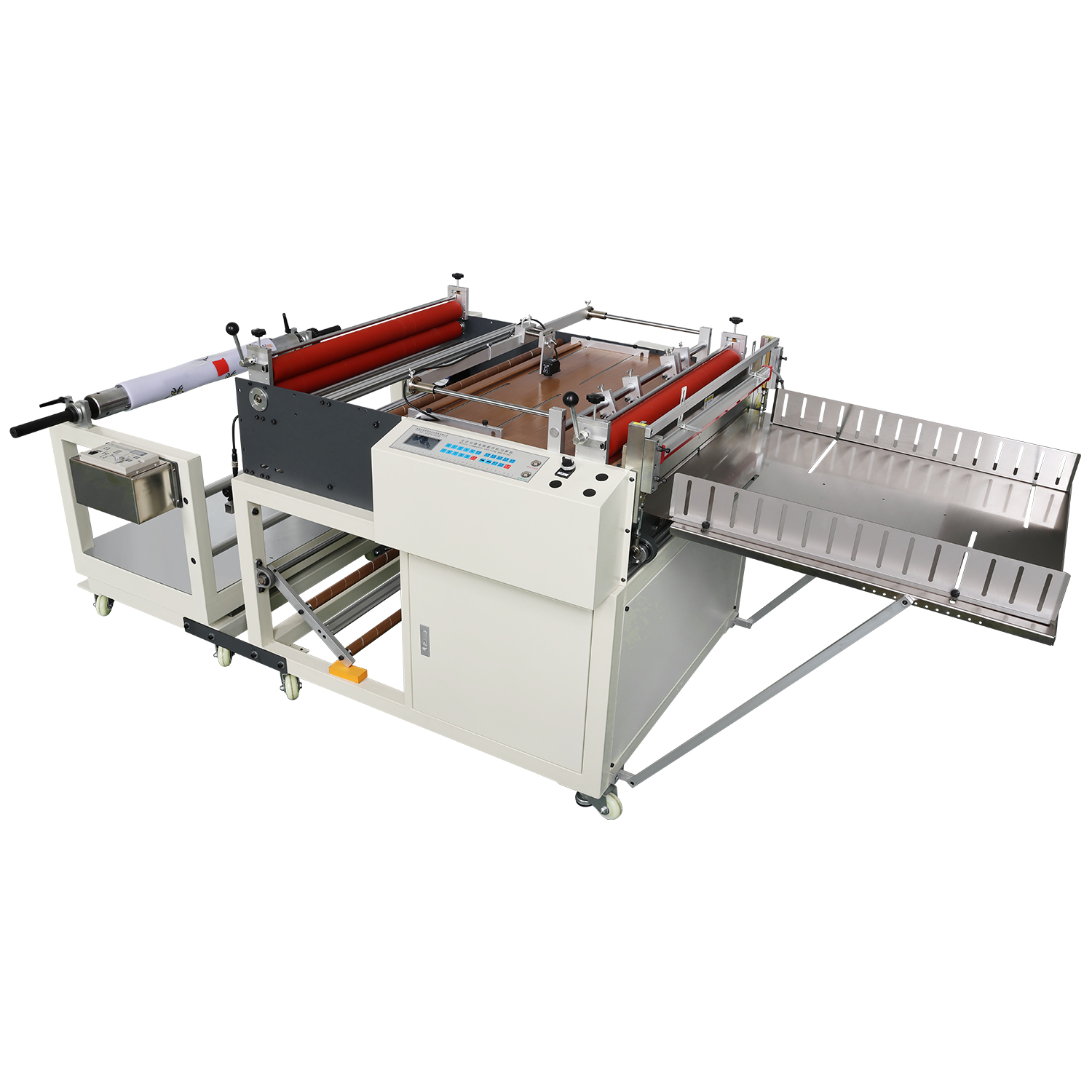
Because these machines pursue different end-products, their internal engineering solves completely different physical problems. Let us examine the specific technologies driving both systems.
Sheet cutters must feature dedicated "leveling" technology. When you unwind material from a master roll, it retains a physical memory of its curved state. Engineers call this "coil set." If you simply cut a piece of material right off the roll, it will curl up on your table. To solve this, sheet cutters use leveling banks. These banks force the web through alternating rollers, bending the material slightly past its yield point in both directions. This erases the curvature memory. The sheet then lays perfectly flat for precise shearing.
Slitters tackle a totally different stress factor: web tension. They do not flatten the material. Instead, they rely on magnetic powder clutches and automated tension controllers. These components keep the web taut from the unwind stand to the rewind shafts. If tension drops, the material wrinkles before hitting the blades. If tension spikes, the material stretches or snaps. Slitting engineering revolves entirely around maintaining consistent linear pull.
The actual cutting tools vary drastically between the two formats. Slitting relies on continuous friction, while sheet cutting relies on sudden impact or shearing force.
Slitting Blade Setups:
Razor Slitting: Operators place stationary razor blades in the material path. It offers low setup costs but generates high friction heat. It works best for very thin films.
Shear Slitting: This uses rotating male and female circular blades acting like scissors. It delivers highly precise, smooth edges with low dust generation. It is ideal for paper, foils, and laminates.
Crush/Score Slitting: A pneumatically loaded dull circular blade presses down onto a hardened anvil roller. It violently separates the web. It handles non-wovens and abrasive materials well but creates rougher edges.
Sheet Cutting Systems:
Guillotine Shears: A heavy upper blade drops down onto a stationary lower blade. The web must physically stop for a fraction of a second to allow the cut.
Flying Shears: The cutting carriage accelerates to match the exact speed of the moving web. It cuts the material without stopping the line, enabling much higher production volumes.
Rotary Shears: Cylinders equipped with horizontal cutting blades spin in synchronization with the web speed, snipping the material as it feeds through.
When you evaluate capital equipment, you must look beyond initial capabilities. You need to understand how these machines operate over long shifts, how they fail, and how they impact your facility's cleanliness.
Evaluation Criteria | Slitting Machines (Roll-to-Roll) | Sheet Cutting Machines (Cut-to-Length) |
|---|---|---|
Production Velocity | Exceptionally fast. Often runs between 150m/min to 300m/min due to continuous motion. | Inherently slower. Typically maxes out around 80m/min due to stop-and-go transverse cycles. |
Blade Maintenance | Requires constant monitoring of alignment and heat. Razors need frequent swapping. | Requires heavy sharpening of shear blades (SKD11/Carbide) and hydraulic seal servicing. |
Dust Generation | Can be high (especially with crush slitting). May require vacuum extraction webs. | Generally low dust. Guillotine shears produce a clean, sudden break in the material. |
Scalability Limits | Limited by the rewind shaft's weight capacity and maximum motor torque limits. | Limited by the physical length of the run-out table and automated stacking logistics. |
Maintenance teams face distinct challenges with each system. Slitting requires delicate precision. A fraction of a millimeter misalignment in a shear slitting setup will cause excessive blade wear and ragged material edges. Razor slitting requires operators to constantly check for friction heat buildup, which can melt sensitive polymer films.
Sheet cutting demands heavy industrial maintenance. You must regularly unbolt the heavy shear blades—often crafted from SKD11 tool steel or Tungsten Carbide—and send them to specialized grinding facilities. Furthermore, the pneumatic or hydraulic cylinders driving the leveling rollers require strict fluid monitoring to maintain consistent flattening pressure.
Some facilities face a dilemma. They need to reduce the width of a master roll, but they ultimately need the material delivered as flat sheets. Purchasing two separate machines consumes too much capital and floor space.
Equipment builders solve this by offering a composite system. A Roll To Sheet Slitting Machine performs longitudinal slitting followed immediately by transverse cut-to-length shearing. The material unwinds, passes through a bank of rotary slitting blades to become multiple narrow strips, and then feeds directly into a guillotine shear to become small rectangular blanks.
Reduced Footprint: It eliminates the need to buy and position two entirely separate production lines on your factory floor.
Handling Efficiency: You eliminate intermediate material handling. Operators no longer waste time moving slit daughter rolls to a separate cutting station.
Labor Optimization: One operator can oversee both the width reduction and the final length cut simultaneously.
Increased Capital Expenditure: Combining two complex material handling processes into one chassis requires expensive, heavy-duty engineering.
Single Point of Failure: If the transverse shear system requires maintenance or breaks down, your slitting capability goes offline alongside it.
Operational Complexity: This machine requires highly skilled technicians. The operator must program complex PLC systems that balance continuous unwinding tension with the intermittent, stop-and-go feed required by the guillotine shear.
Choosing the right machine depends entirely on your downstream manufacturing processes. Apply this strategic matrix to map your facility's exact needs against the equipment capabilities.
Facility Requirement | Recommended Solution | Technical Justification |
|---|---|---|
Feeding automated wrapping or high-speed stamping presses | Slitting Machine | These secondary processes require continuous roll-fed material to function at peak speed. |
Creating blanks for localized folding, bending, or manual assembly | Sheet Cutting Machine | Flat panels are required for press brakes. Coil set must be removed prior to bending operations. |
High-volume, standardized single-format output | Dedicated Single Machines | Maximizes throughput speed. Continuous slitting runs faster when unburdened by cross-cutting cycles. |
High-mix, customized batches requiring varied widths and lengths | Hybrid Combined Machine | Offers ultimate flexibility. Allows rapid changeovers to produce unique blanks without moving material. |
You must strictly match the machine to your material's physical load. Do not force light-duty machines to process heavy materials. Standardize your procurement using these three industry tiers:
Light-Duty: Engineered for thin films, paper, foils, and metal coils up to 0.3mm thick. These machines prioritize high-speed servo motors and razor precision.
Medium-Duty: Built for thicker plastics, cardboard, and metal plates up to 3mm thick. They require upgraded shear mechanics and heavier frames.
Heavy-Duty: Designed exclusively for thick metal processing (e.g., steel up to 16mm). These lines require massive hydraulic power and heavily reinforced leveling banks to flatten the rigid material.
Once you identify your required machine type, you must evaluate the vendor. The converting equipment market contains massive variations in build quality. A poorly engineered machine will ruin expensive master rolls and stall your operations.
A reputable Roll to sheet cutting machine manufacturer should operate with total transparency regarding component metallurgy. Do not accept vague terms like "high-quality steel." Ask specifically what grade of steel they use for the shearing blades. Industry-standard machines utilize SKD11 tool steel or specialized Tungsten Carbide. You should also demand data on the expected cut lifecycle before the blade requires professional sharpening.
Evaluate the human-machine interface (HMI) and Programmable Logic Controller (PLC) systems. Older or cheaper machines rely on manual dial adjustments for cut lengths, which invites human error. Modern manufacturers should provide digital touchscreens that allow you to save specific job recipes. Furthermore, ask if the vendor can integrate automated uncoilers and hydraulic auto-stacking tables. Automating material handling severely reduces operator fatigue and forklift bottlenecks.
Never take delivery of a machine based purely on a brochure. Advise your procurement team to demand a rigorous Factory Acceptance Test (FAT). You must ship your exact proprietary master roll materials to the manufacturer's facility. Watch the machine process your actual product. Force the vendor to prove their equipment can hold precision tolerances (e.g., transverse cuts within ±0.1mm) before you sign the final payment release.
We must reiterate one fundamental truth: slitting and cutting are not competing technologies. They represent complementary stages within the broader material converting lifecycle. Slitting optimizes width for continuous secondary processing, while cutting to length finalizes the material into a discrete, usable flat format.
To move forward, take the following steps:
Audit your inventory: Calculate exactly how much capital you have tied up in custom-width master rolls from third-party suppliers.
Map your downstream needs: Walk your factory floor and determine if your secondary stations consume rolled goods or flat blanks.
Consult engineering: Work with your mechanical team to calculate the exact ROI timeline of bringing this specific processing line in-house.
Demand material trials: Shortlist three vendors and initiate material testing to ensure their leveling and tension mechanics match your quality standards.
A: No. Standard slitting machines only slice materials longitudinally to reduce width, immediately rewinding the output onto new cores. If you need both longitudinal slicing and transverse cross-cutting, you must invest in a combined Roll To Sheet Slitting Machine.
A: Leveling permanently removes the curvature memory, commonly known as "coil set," from the unwound master roll. By bending the material through offset rollers, the machine relieves internal stresses so the final severed sheet sits perfectly flat on your assembly tables.
A: Both machine types feature highly customizable mechanics. Manufacturers can engineer them to process an expansive range of flexible and rigid web materials. Common applications include delicate paper, flexible packaging films, aluminum foil, heavy cardboard, and thick gauge steel coils.
