Introduction
In modern packaging factories, speed shapes competitiveness more than ever. A High Speed Bag Sealing And Cutting Machine enables manufacturers to deliver large volumes with stable quality and predictable schedules. As a core upgrade to the Bag Making Machine production line, it transforms raw film into finished bags through automated sealing, cutting, and collection. This article explains how high-speed systems support scalable output, process control, and efficient planning, helping manufacturers stay reliable, flexible, and cost-effective in demanding production environments.
What Defines a High Speed Bag Sealing And Cutting Machine
Integrated Automation in a Modern Bag Making Machine
A high speed bag sealing and cutting machine is defined by how completely it integrates production stages. Film unwinding, tension control, sealing, cutting, and stacking operate as one synchronized system. Instead of relying on operators to align film or adjust timing, the Bag Making Machine manages these steps automatically. This integration reduces variation between batches and keeps output consistent across long shifts. It also simplifies training, since operators interact mainly through a central control panel rather than multiple mechanical points.
High-Speed Output and Production Consistency
Speed alone does not define performance. What matters is sustained output without quality drift. Industrial high speed systems commonly reach 150 to 600 bags per minute, depending on bag size and material. At these rates, the Bag Making Machine must maintain uniform bag length and seal strength. Servo-driven feeding and controlled sealing cycles ensure that every bag meets the same specification, even during continuous operation. This consistency supports long production runs and reduces downstream inspection pressure.
Precision Control Systems Behind High-Speed Performance
Behind high-speed performance sits a precision control architecture. PLC systems coordinate each motion, while servo motors manage feeding and cutting accuracy. Photoelectric sensors track printed marks and edge positions, allowing precise cuts on printed films. In a modern Bag Making Machine, these systems work together to keep millimeter-level accuracy at high speed. Precision control not only protects quality but also reduces waste caused by misalignment or incorrect cutting lengths.
Core Working Process of High Speed Sealing and Cutting
Film Feeding and Tension Management
The process begins at the unwinding station. Film rolls feed into the machine through automatic shafts and closed-loop tension systems. Sensors monitor tension in real time, and the Bag Making Machine adjusts motor torque instantly. This prevents stretching, wrinkling, or sudden slack during acceleration or deceleration. Stable feeding ensures that sealing and cutting actions remain accurate, even when production speed changes during a run.
Heat Sealing Technology for Reliable Bag Closure
Heat sealing defines bag strength and usability. High speed machines use bottom seal, side seal, or combined systems depending on bag type. Temperature, pressure, and dwell time are digitally controlled to match film characteristics. In a well-configured Bag Making Machine, sealing knives heat evenly and cool efficiently, supporting continuous cycles without deformation. This produces strong, leak-resistant seals suitable for retail, food, or industrial use.
Cutting Accuracy and Finished Bag Collection
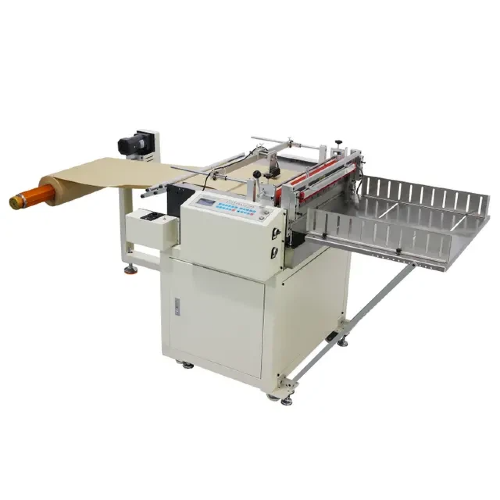
In high-speed bag production, cutting precision and output handling determine whether upstream sealing quality can be fully preserved. Length control, cutting response time, and downstream collection must work as one coordinated system to keep bags uniform, organized, and ready for packing without secondary manual operations.
| Aspect | System Configuration | Key Technical Indicators (Reference) | Practical Application | Operational Notes |
| Cutting Drive Method | Servo motor–driven rotary or flat knife | Cutting response time ≤ 20 msRepeat positioning accuracy ≤ ±0.5 mm | High-speed flat bags, T-shirt bags | Servo tuning must match line speed to avoid lag |
| Length Control | Encoder + servo synchronized feeding | Bag length deviation ≤ ±1 mm at 300–600 bags/min | Retail and courier bags with strict size tolerance | Encoder resolution typically ≥ 1000 PPR |
| Sensor Positioning | Photoelectric sensor or color mark tracker | Detection accuracy ≤ ±0.3 mm on printed film | Printed logo bags, branded packaging | Sensor lens cleanliness affects long-run accuracy |
| Knife Material & Life | Alloy steel or hardened tool steel | Typical blade life: 20–40 million cuts | Continuous industrial production | Blade wear increases burr risk if not monitored |
| Cut Edge Quality | Optimized knife geometry + tension balance | Edge burr height ≤ 0.1 mm (film dependent) | Food and medical packaging bags | Excessive tension can deform cut edges |
| Counting System | Electronic counter linked to PLC | Counting error ≤ 0.2% per stack | Batch packing and carton loading | Stack size presets reduce downstream handling |
| Stacking Mechanism | Pneumatic or servo-assisted stacker | Stable stacking height: 50–200 bags per stack | Manual packing, automated bagging lines | Stack alignment depends on bag stiffness |
| Conveying Output | Belt or roller conveyor | Conveyor speed matched within ±5% of cutting speed | Direct transfer to packing stations | Speed mismatch may cause bag overlap or skew |
Tip:For stable long-term accuracy, cutting and stacking systems should be evaluated together rather than independently. A Bag Making Machine with well-matched servo cutting and output conveying reduces rework, simplifies packing workflows, and maintains dimensional consistency across full production shifts.
Key Performance Advantages for Bag Making Machine Lines
Productivity Gains in Mass Bag Production
In mass production environments, productivity depends on stable continuous operation rather than peak speed alone. High-speed sealing and cutting systems maintain synchronized feeding, sealing, and cutting cycles, which reduces micro-stoppages that limit real output. A well-calibrated Bag Making Machine can sustain high utilization rates across full shifts, allowing manufacturers to plan capacity based on actual throughput. This predictability supports contract manufacturing, short lead times, and balanced labor deployment across multi-line factories.
Material Efficiency and Waste Reduction
Material efficiency improves when process variability is controlled. Precision servo feeding and closed-loop tension systems reduce film misalignment during acceleration and deceleration phases. Consistent sealing temperature and cutting position prevent partial seals and length deviation. As a result, a high-speed Bag Making Machine lowers startup scrap and stabilizes yield during long runs. Reduced waste not only cuts raw material cost but also simplifies recycling and internal material handling within the plant.
Energy-Efficient Operation at High Speed
Energy efficiency at high speed is achieved through adaptive power management. Variable frequency drives regulate motor output based on real-time load rather than fixed-speed operation. Servo systems recover positioning accuracy without excessive torque demand. In a modern Bag Making Machine, this balance keeps thermal systems stable and avoids unnecessary energy spikes. Lower energy consumption per unit improves cost control and supports long-term operational planning in energy-sensitive manufacturing regions.
Supported Bag Types and Material Compatibility
Common Bag Styles Produced at High Speed
High-speed production supports standardized geometry and repeatable forming accuracy across different bag styles. T-shirt bags rely on precise handle punching and uniform side sealing, while flat and bottom-sealed bags depend on stable web tracking and transverse seal strength. A flexible Bag Making Machine uses interchangeable forming frames and stored parameter sets to maintain dimensional accuracy when switching styles. This reduces setup deviation and allows consistent output quality across diverse retail and industrial packaging formats.
Compatible Materials for Sealing and Cutting
Material behavior under heat and pressure defines sealing quality. HDPE favors higher pressure with moderate temperature, while LDPE requires lower pressure and longer dwell time. PP and OPP films demand tighter temperature control due to narrower sealing windows. A well-configured Bag Making Machine enables independent adjustment of temperature, pressure, and time, allowing operators to match sealing conditions to polymer characteristics and maintain smooth cut edges across multiple film types.
Customization Options in Bag Making Machine Systems
Customization focuses on functional add-ons rather than structural changes. Handle punching units, perforation devices, and print mark tracking modules are typically integrated through standardized mounting points. A modular Bag Making Machine allows these functions to be activated or removed without affecting core motion systems. This approach supports short product cycles, frequent design updates, and fast response to brand-driven packaging requirements.
Selecting the Right High Speed Bag Sealing And Cutting Machine
Matching Production Speed to Order Volume
Selecting production speed should start from order structure rather than maximum machine capability. Average daily output, batch size, and delivery frequency determine the most efficient operating range. Running a Bag Making Machine close to its optimal speed window improves thermal stability, tension control, and seal consistency. Oversized capacity often leads to frequent stop–start cycles, while correctly matched speed supports steady operation, balanced labor allocation, and more accurate production scheduling across shifts.
Bag Size, Thickness, and Seal Requirements
In high-speed bag production, bag dimensions and film thickness directly affect sealing structure, heating parameters, and overall machine cycle time. Breaking these factors down in a structured way helps manufacturers select and configure a Bag Making Machine that maintains stable quality and repeatable performance across different product specifications.
| Dimension | Typical Bag Specifications | Impact on Bag Making Machine | Key Technical Parameters (Reference) | Typical Applications | Practical Notes |
| Bag Width | 80–300 mm (small)
300–600 mm (medium)
600–1000 mm (large) | Determines sealing knife length, machine frame width, and transverse tension distribution | Effective sealing width ≥ bag width + 20 mm
Lateral tension deviation ≤ ±3% | Retail bags, garbage bags, industrial sacks | Confirm guide rollers and EPC correction range for wide bags |
| Bag Length | 100–400 mm (short)
400–800 mm (standard)
800–1500 mm (long) | Affects feeding rhythm and sealing–cutting cycle time | Length accuracy ≤ ±1 mm (servo + encoder control) | T-shirt bags, courier bags, agricultural bags | Long bags are more sensitive to inertia at high speed |
| Film Thickness (single layer) | 8–20 μm (ultra-thin)
20–50 μm (standard)
50–120 μm (thick film) | Determines heating power, sealing pressure, and cooling duration | Sealing pressure: 0.3–0.6 MPa
Heating power: 2–3 kW (standard range) | Food packaging, daily-use bags, heavy-duty bags | Thick films require longer cooling to avoid seal rebound |
| Material Type | HDPE, LDPE, PP, OPP, biodegradable films | Different melting points and thermal shrinkage behaviors | HDPE sealing temp: 130–160 °C
LDPE sealing temp: 110–140 °C | Supermarket bags, medical pouches, eco bags | Do not reuse identical temperature settings across materials |
| Seal Structure | Bottom seal, side seal, three-side seal | Defines sealing knife design and motion mechanism | Seal width: 2–8 mm (typical)
Seal strength ≥ 80% of film tensile strength | Flat bags, garbage bags, packaging bags | Seal width must match load-bearing requirements |
| Production Speed Matching | 150–300 bags/min
300–600 bags/min | Larger size and thicker film reduce achievable top speed | Tension fluctuation ≤ ±5% in high-speed mode | High-volume standardized orders | Allow speed margin when switching specifications |
| Changeover Frequency | Single specification
Frequent multi-spec change | Influences setup time and production continuity | Recipe recall time ≤ 2 min (parameterized control) | OEM production, flexible manufacturing | Servo-driven systems suit frequent changeovers |
Tip:When selecting equipment, it is best to evaluate the Bag Making Machine using the combination of maximum bag width and maximum film thickness rather than average specifications. This approach leaves enough process margin for future product expansion and reduces the need for structural upgrades later.
Integration with Existing Bag Making Machine Lines
Effective integration determines how much value a new system can deliver. A high-speed unit should synchronize line speed, signal interfaces, and mechanical alignment with upstream printing and downstream conveying equipment. Matching servo control logic and communication protocols helps prevent bottlenecks and material buffering. When a Bag Making Machine is integrated as part of a continuous line, film flow remains stable, transition losses are reduced, and overall equipment utilization improves across multi-process production environments.
Industrial Applications Driving Demand for High-Speed Machines
Retail and Consumer Packaging
Retail packaging operates under strict timing and visual standards. High-speed production ensures shelves are replenished without interruption, especially during peak sales periods. In this context, a Bag Making Machine must deliver stable bag dimensions, smooth sealing edges, and clean cutting to support brand presentation. Consistent bag thickness and handle alignment help retail chains maintain uniform store images. High output capacity also allows suppliers to respond quickly to promotional demand spikes while keeping unit costs predictable.
Food and Medical Packaging
Food and medical packaging places priority on seal integrity and process control. High-speed systems use precisely regulated temperature and pressure to create uniform seals that resist leakage and contamination. A precision Bag Making Machine supports hygienic production by reducing manual contact and maintaining repeatable sealing parameters across long runs. Stable sealing performance also simplifies quality audits and supports compliance with industry packaging standards, which strengthens trust across food distributors and healthcare supply chains.
Industrial and Logistics Packaging
Industrial and logistics packaging emphasizes durability and throughput. Bags used for courier, warehouse, or bulk transport must tolerate mechanical stress during handling and stacking. High-speed sealing and cutting equipment enables continuous production of thick-film bags with reinforced seals. A robust Bag Making Machine maintains sealing strength and dimensional accuracy even at high output rates, allowing logistics operators to standardize packaging while supporting large daily shipment volumes.
Conclusion
A High Speed Bag Sealing and Cutting Machine enables fast, stable, and scalable bag production.
It integrates automation, precision control, and energy efficiency in one Bag Making Machine line.
Manufacturers gain higher output, consistent quality, and lower operating costs across applications.
With advanced solutions from HDK Automation Equipment Co., Ltd., companies benefit from reliable equipment, flexible configuration, and professional service that support long-term production growth.
FAQ
Q: What is a High Speed Bag Sealing And Cutting Machine?
A: It is an automated Bag Making Machine that seals, cuts, and stacks bags at high speed.
Q: How does a Bag Making Machine improve production efficiency?
A: A Bag Making Machine runs continuously, reducing manual handling and increasing daily bag output.
Q: Why choose high-speed sealing and cutting for packaging?
A: High-speed systems use a Bag Making Machine to ensure stable quality and faster order delivery.
Q: What bag types can a Bag Making Machine handle?
A: A modern Bag Making Machine produces flat bags, T-shirt bags, and bottom-sealed bags.
Q: How does cutting accuracy affect finished bags?
A: Precise servo control in a Bag Making Machine keeps bag length consistent and reduces waste.


