

Views: 0 Author: Site Editor Publish Time: 2026-11-09 Origin: Site
Manufacturing continuous roll materials often hits a critical factory bottleneck. Converting web formats like paper, films, and printed laminates into discrete, accurately sized sheets remains notoriously difficult. Standard cutting machines rely heavily on fixed-length feeding mechanisms. This rigid mechanical assumption leaves your production highly vulnerable. Tension drift, material stretching, and print misalignment occur naturally over long production runs. Over hours of continuous operation, these micro-errors compound into unacceptable offcut waste.
The modern resolution lies in optical feedback loops. We introduce the Eye Position Roll To Sheet Cutting Machine as the new engineering standard for printed material processing. It utilizes advanced photoelectric tracking to verify actual print marks. It never relies solely on assumed mechanical feed lengths.
This article gives operations and procurement leaders an objective evaluation framework. You will learn how to assess equipment capabilities accurately. We will help you calculate operational returns and assess physical implementation requirements before making a capital investment.
Precision via Feedback Loops: Eye position sensors (photoelectric tracking) enable auto-correction, anchoring the cut to printed eye-marks rather than assumed mechanical distance.
Tangible ROI: Direct cost savings stem from minimized offcut waste, reduced labor overhead, and lower scrap rates on high-value substrates.
Procurement Benchmarks: Buyers must evaluate machines based on tension control capabilities, maximum roll diameter limits (e.g., 400mm vs. 1000mm), and rapid-change safety features.
Supplier Vetting: A reliable supplier will provide transparent maintenance expectations, proven VFD/Servo architectures, and clear warranty terms.
Mechanical cutters often fail spectacularly when processing printed substrates. Minor tension variations happen naturally as roll diameters decrease during operation. Material elasticity also plays a massive role in feeding inaccuracy. In standard fixed-length machines, these tiny shifts compound rapidly over time. The cutting line slowly drifts away from the intended printed design boundary. We classify this progressive failure as the "drift" problem.
This physical inaccuracy carries heavy downstream financial costs. Misaligned cuts instantly waste expensive substrates like vinyl or laminated foils. Quality control teams must then manually inspect the output. They reject flawed batches to protect brand integrity. This manual intervention creates severe bottlenecks on your factory floor. You lose both valuable material yield and critical operational time.
The primary goal of any Roll to sheet cutting machine centers on managing the transition from continuity to discreteness. You are converting a continuous web into discrete, uniform sheets. Success demands zero-margin errors on printed boundaries. You must also maintain high cycle speeds without ever sacrificing cutting tolerance. Standard blind-feeding equipment simply cannot meet these strict discrete production standards.
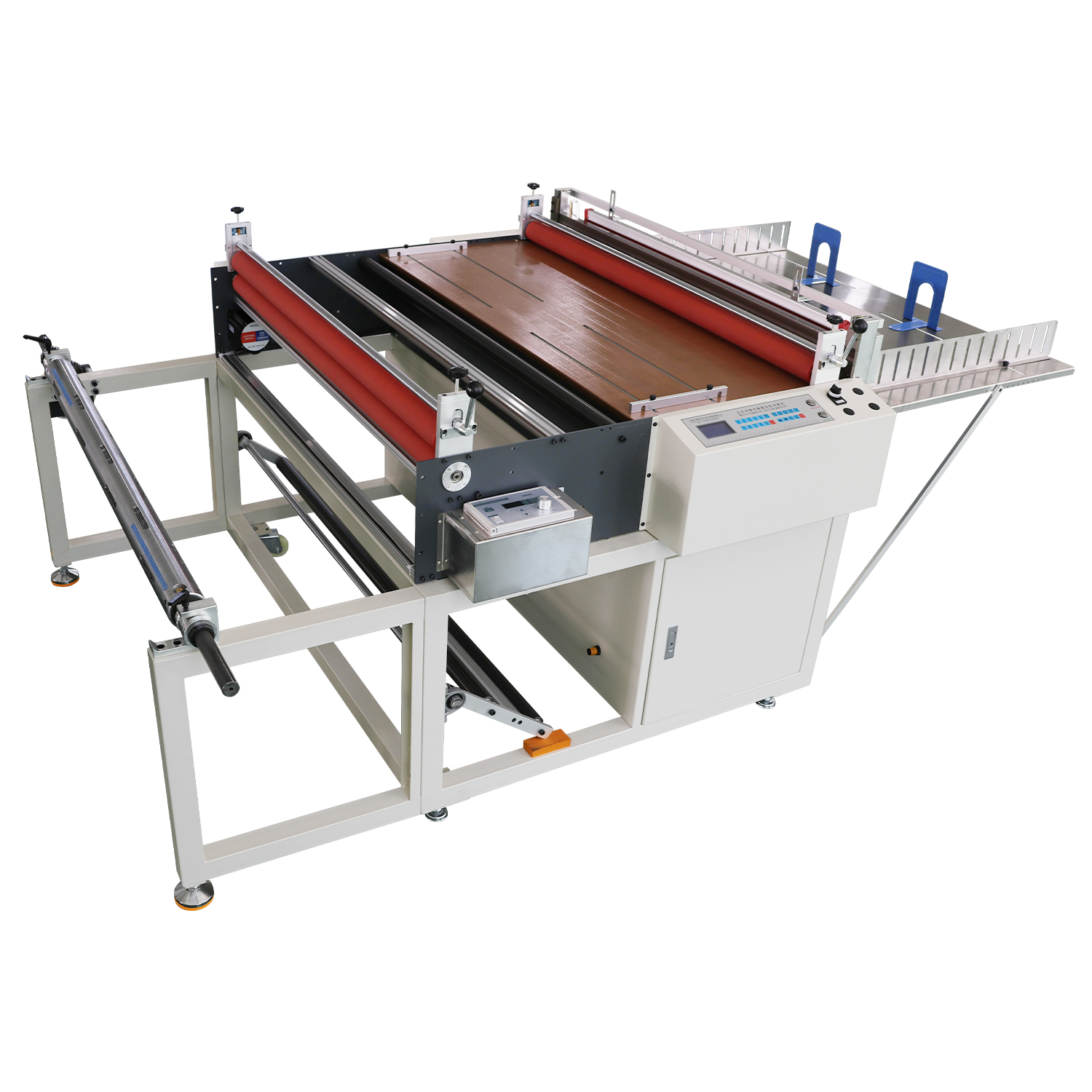
Photoelectric eye-mark sensors form the technical core of this tracking machinery. These advanced optical units emit a concentrated light signal onto the moving web. They actively scan for specific colored registration marks printed directly on the substrate. The sensor easily detects high-contrast red, blue, or green squares. Once detected, the sensor feeds this exact real-time positional data back to the central controller.
This scanning creates a seamless mechanical-electrical handshake. The moment the sensor detects the registration mark, it triggers the internal logic. It signals the Variable Frequency Drive (VFD) and the primary servo motors. The feed rollers pause instantly and precisely at the target location. The cutting sequence then initiates, dropping the heavy blade exactly on the registration line. Once the blade retracts, the entire web cycle resets in fractions of a second.
High-end models rely heavily on robust auto-correction mechanisms. The internal Programmable Logic Controller (PLC) uses high-resolution encoders to adjust feed lengths on the fly. Sometimes the material skews slightly. Sometimes a thick splice joint passes through the rollers. The PLC compensates automatically for these physical anomalies. It anchors the cut strictly to the visual mark every single time.
Transitioning to optical tracking completely transforms your factory baseline. Uncompromising precision ranks as the most immediate and visible benefit. Targeting a printed eye-mark guarantees uniform margins across thousands of individual sheets. It virtually eliminates operator guesswork. Your teams no longer need to perform manual measurement checks during active runs.
Material optimization directly improves your operational profit margins. Tight tolerances mean you slice exactly where needed. The machine eliminates jagged edges and drastically reduces costly offcuts. You maximize the total usable yield from every single roll you process. This waste reduction quickly justifies the equipment upgrade, especially when running high-value specialty films.
Operational efficiency leaps forward through smart industrial automation. You shift away from manual web guidance toward fully programmable processing cycles. This shift enables powerful labor reallocation.
Operators load the raw roll and thread the web material.
They program the batch size and cycle speed via the touchscreen interface.
The machine runs autonomously, allowing operators to handle packaging tasks.
Modern compact iterations optimize your active floor space utilization. Traditional cutting lines require massive facility footprints. Multi-stage processing setups waste valuable real estate. An integrated optical cutter handles feeding, tracking, and slicing in one highly compact footprint. You reclaim factory space for other revenue-generating downstream processes.
Buying industrial processing equipment requires strict technical vetting. First, verify substrate and dimension compatibility. Check the maximum allowable roll width limits. The standard usable width usually equals the machine's stated width minus about 30mm of operational clearance. You must also evaluate roll diameter limits carefully. A standard 400mm capacity works perfectly for thin paper. However, bulky items like packaging bubble wrap demand advanced 1000mm unwind stations.
Evaluate the internal drive system quality rigorously. Look for reliable closed-loop servo drives paired with robust PLCs. Avoid outdated stepper motor configurations. Steppers often lose positional steps at high speeds, which instantly degrades your cutting tolerance.
Assess multi-functionality to future-proof your equipment investment. Determine if the machine supports simultaneous longitudinal slitting and cross-cutting. Ask if you can add optional hardware modules for inline creasing or barcode reading later.
Never compromise on physical safety mechanisms. Automated blade retraction prevents severe workplace injuries. Emergency stop protocols ensure immediate shutdown during jams. Transparent physical guards limit workplace liability while protecting your factory workforce from moving parts.
Evaluation Criteria | Standard Mechanical Cutter | Optical Eye-Mark Cutter |
|---|---|---|
Feed Control Method | Fixed mechanical length programming | Real-time optical sensor feedback |
Tolerance Drift | High (errors compound over long runs) | Virtually zero (resets per printed mark) |
Material Waste Factor | Significant offcuts and rejected batches | Maximized yield, minimized offcut scrap |
Motor Architecture | Often relies on baseline open-loop steppers | Uses high-response servo motors & VFDs |
Even the best optical sensors cannot fix poor physical setups. Tension control calibration remains a harsh implementation reality on the floor. Improper tension settings will cause the web material to curl or skew laterally. The sensor reads the mark perfectly, but slack material causes a severe diagonal cut. You must provide proper operator training on adjusting manual or magnetic powder tensioning brakes.
Maintenance downtime directly dictates your overall daily profitability. You need realistic maintenance expectations to schedule your production effectively. Replacing a dulled blade on a well-engineered unit should take between 5 and 10 minutes. Quick-change hardware designs prevent minor wear-and-tear from causing prolonged production halts.
Your floor operators must know how to troubleshoot common faults rapidly.
Regularly inspect the upper and lower blades to ensure crisp cuts.
Check the heavy feed roller alignment daily to prevent tracking issues.
Wipe down the optical lenses routinely to maintain sensor clarity.
Symptom observed | Likely Underlying Cause | Recommended Action |
|---|---|---|
Jagged or Frayed Edges | Blade dullness or incorrect cutting cylinder pressure. | Replace the blade (5-10 min) or increase downward pressure. |
Material Feed Jams | Misaligned feed rollers or excess unwind web tension. | Re-align feed rollers and recalibrate tension brakes. |
Sensor Misses Mark | Dust on the photoelectric lens or length drift errors. | Clean the sensor lens and recalibrate the length limits. |
Choosing the right manufacturing partner matters as much as the machine specifications. A trustworthy Eye Position Roll To Sheet Cutting Machine supplier prioritizes strict engineering transparency. They will openly discuss exact machine tolerances, often hitting precise ±0.015 inch margins. They clearly state their internal PLC brands and outline maximum safe cycle speeds.
Evaluate their dedicated after-sales support and spare parts availability. Your internal maintenance team needs accessible electrical schematics to resolve issues. You also need guaranteed fast shipping for critical consumables. Waiting weeks for replacement blades, photoelectric sensors, and solid-state relays cripples factory output.
Finally, review the baseline warranty and hardware pricing structure carefully. Standard industry expectations should cover electronic components for at least one year. Heavy mechanical components usually carry a solid two-year warranty. Ensure the supplier provides a highly straightforward pricing model. Look out for hidden factory integration fees or mandatory software licenses that inflate your initial capital expenditure unexpectedly.
Upgrading your facility with an advanced eye-mark tracking system serves as a defensive industrial investment. It actively protects your raw material yield and guarantees strict product consistency across massive production batches. By shifting from blind mechanical feeding to optical verification, you eliminate the costly risks associated with tension drift.
To move forward effectively, we recommend these concrete next steps:
Audit your current factory floor output to determine exact offcut waste percentages over a standard 30-day period.
Define your strict capability requirements, focusing heavily on maximum required roll diameters and minimum acceptable cycle speeds.
Contact your shortlisted equipment suppliers to request custom test cuts using your exact printed substrate samples.
A: These machines offer immense versatility across manufacturing sectors. They seamlessly process paper, cardboard, textiles, plastic films, and multi-layer laminates. They easily handle specialized packaging materials like Teflon sheets or heat transfer vinyl. The only strict requirement is that your printed eye-mark contrasts adequately against the material's background color so the optical sensor can detect it reliably.
A: The primary difference lies in closed-loop automated feedback. Standard mechanical machines cut blindly based on pre-programmed lengths. They cannot adjust if the paper stretches mid-run. Eye-position machines verify the exact cut location optically before dropping the blade. They adapt dynamically to print variations, ensuring the cut always aligns with the graphic.
A: Baseline automatic models designed for narrow webs generally start around $5,500. If you require high-speed servo capabilities, wide-format dimensions, and integrated slitting modules, commercial-grade industrial units cost upwards of $12,000. Final pricing depends heavily on machine width, internal motor quality, and specific customized automation features.
A: Yes, they integrate smoothly into established factory workflows. You can sync them directly with upstream roll-to-roll printers for immediate continuous processing. You can also connect them to downstream automated stackers or packaging conveyors. This seamless physical integration eliminates material handling bottlenecks and reduces manual transfer labor between stations.
